We'd planned to just spend the weekend messing about once we got Ishtar to Dale. Louise wanted to get some practice just sailing from place to place and dropping the anchor for a short wait before setting off again. We headed just around the corner from Dale to castlebeach bay, where she set the anchor perfectly, before taking Tigger ashore to inspect the beach for sticks, and have a swim.
She'd spotted a small tear in the mainsail on the way around, so quickly set about sewing that
before hauling the anchor and setting off for a short sail across to Sandy Haven bay. Once more she set the anchor before the tell tale patter of raindrops on Ishtar's topsides began. I was surprised, but Louise was not. She told me that the forecast was for very heavy rain - the forecast I'd seen had given light winds and fair weather.
Within an hour, Ishtar was starting to bounce around. We had considered sailing through the port and up river to spend the night at Llangwm, but a look outsaide showed that the rain was so heavy, the visibility was down to around 100m. We set off for Dale.
We quickly realised that we should have gone back sooner, as we rounded Great Castle Head. The wind indicator was showing 28-30 knot gusts from the West, blowing hard pointy rain drops into our faces. With the current against us too, we motored, making only around 2 knots, and it took us nearly an hour to get back to Dale - a very unpleasant trip indeed.
This was further compounded when we got to the mooring to find that one of our two mooring lines had sunk, meaning that I was forced to sit in the dinghy, bucking in the rough seas, fishing about under the bouy until I found it.
By the time we got below, I was soaked to the skin, and freezing cold.
Louise made some sausages, mash, broad beans, peas and gravy, followed by cheeesecake and a bottle of wine. By about 9pm, the bad weather had passed, and it looked like we might get a good night's sleep.
Nope. As I lay drifting off in the forecabin around midnight, I could feel the wind getting up again. This time the boat started jumping around far more energetically, to the point where I started to feel sick. I very rarely get sick on a boat. I realised that the wind was now blowing straight down the Haven from the East. An hour later the screeching of the wind was as loud as I've heard when aboard, and we spend a very uncomfortable night indeed, and woke bleary eyed, the remains of the gale hampering the racing yachts efforts to get out and sail.
It had calmed down almost completely by 11 o'clock, but we were both knackered and, with Louise working, and plenty of wet clothes to dry, we called it quits and set off home.
Messing about in Ishtar's dirty, oily, smelly passages, covered in diesel, trying to work out why an almost brand new engine keeps cutting out.
Louise wanted to do it. Good. If something were to happen to me, and I became incapacitated, a basic understanding of the engine, and it's subsystems would be invaluable to her. She removed the top of the diesel tank, after removing everything from the cockpit locker and crawling in. We both expected a tank full of diesel bug, and were a bit lost when repeated syphoning and scraping the bottom of the tank produced only clean, white diesel. Not one globular black lump in sight.
Curious.
Louise next removed the main rubber fuel hose that leads from the tank to the primary fuel filter and blew down it. A lot of resistance. Not blocked, but almost. Finally, a blob of rubber hose came out the other end.
There were more lumps in the filter. When she crawled out of the cockpit locker, fuel pipe in hand, things began to make sense.
This pipe was renewed in January, just over 3 months ago. It was soft and sticky, and clearly breaking up. Louise had bought it at a motor factors - it was not marked as 'marine grade'. I don't know what caused it to perish like that, salt, damp, or the diesel itself, but we'd found the problem, and learned another lesson. Buy marine grade fuel hose. A small section of hose connected to the engine, that had been in place for 16 months was still solid, and looked like new. On it's side was stamped 'Marine grade'.
Ho hum. You live and learn.
We spent the rest of the day doing odd jobs - the ones you never do, 'cos they won't take long, but we'd rather go for a sail. That evening it started raining, and the wind picked up. The sound of the wind and rain against Ishtar's hull is lovely when you are tucked up warm inside, on a quiet safe mooring.
In the morning it was still pouring down, and we got soaked as we used the dinghy to go ashore where we'd arranged a lift home from my father.
An enjoyable weekend. Spolied a little by breaking down again, but, I guess, that is par for the course when you mess about in boats.
Ok, not Ishtar, but a similar boat. Camelot is a Colvic Countess 28ft, although a little more in the beam than Ishtar, and a Bilge keeler. Huw, a friend from the club had bought her in Bangor, and wanted to sail her back from there to Cardiff. In January. In one of the coldest winters for years. Non stop.
And didn't we all enjoy it!
Five of us set off to do the trip, all of us nearer 'Last of the Summer Wine' than 'Five go mad in Bangor' although we promised to try. Huw, Allan and Steve went up by car on Wednesday night, readied the boat and launched her.
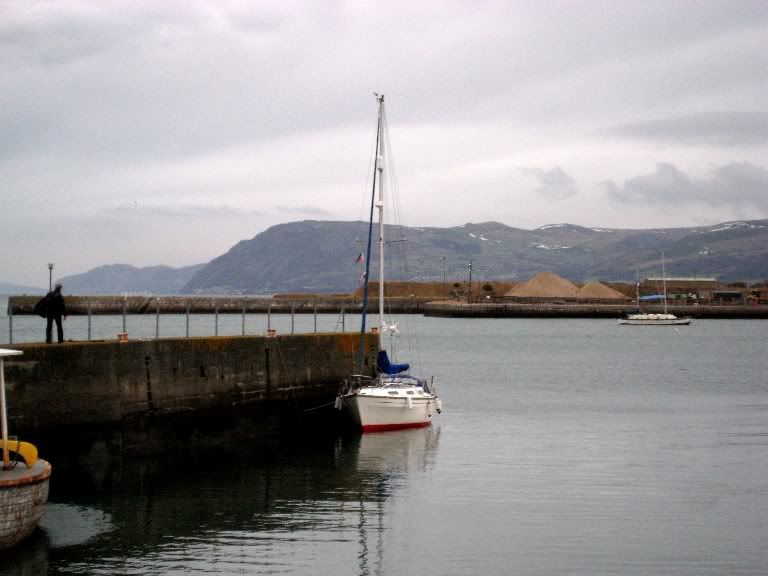
Vince and myself took a train from Cardiff on Thursday, up through the melting snows and sodden ground of mid Wales arriving in a cold overcast Bangor at 16:00. We quickly found Camelot moored against the harbour wall. This was great. It meant that our return from the ale house later would be far simpler. We had anticipated a row out to a mooring.
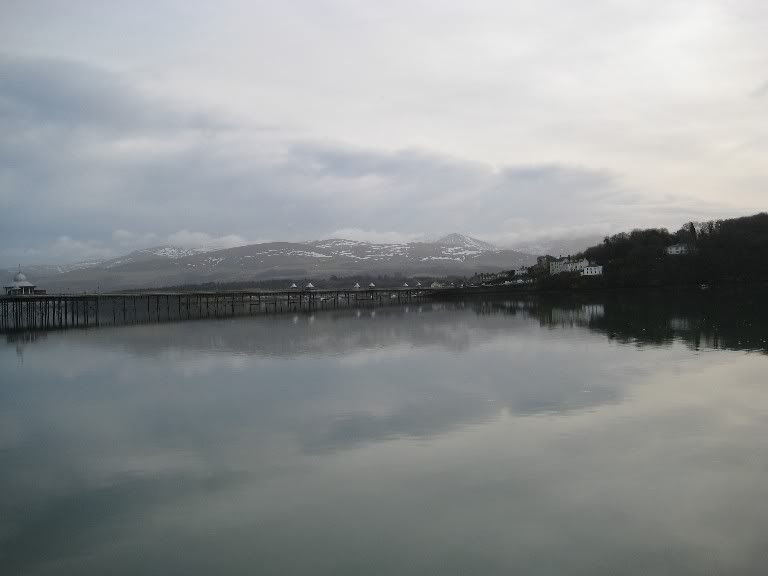
The remains of the recent snows on the North Wales hills, reflected in the cold waters gave it a Scandinavian feel. We walked to the boat where the other lads were waiting for Camelot to settle in the mud before we could go ashore. They seemed to feel that the arrival of Vince and myself increased the noise level substantially. No idea why.......
The boat settled and we did some final calculations. It was important to be away as soon as she floated the following day, in order to make passage through the Menai Straits and out along the Lleyn Peninsula before the tide dropped too far. From there we would cross Cardigan bay at night, traverse the Pembrokeshire islands on Saturday, and then on crossing Carmarthan bay, passing the Gower and up along the Glamorganshire Heritage coast, arriving in Cardiff on Sunday afternoon. That was the plan, at least.
For now, there was little to do. We wandered into Bangor and found a pub that suited us. Old and worn, with real ale and good food. 5:45pm. This was going to be a long one.
After dismantling a giant yorkshire pudding, with sausages, gravy, carrots, peas and chips, and sampling 2 of teh 5 real ales on offer, the Open Microphone night began. I was expecting karaoke, but the flautist, young lady singing the blues in her first ever live performance, and R&B guitar player at the end were very good indeed, as were the remaining three of the 5 real ales on offer.....
I suspect the harbour wall was shaking that night, such was the volume of the snoring aboard Camelot. Half a gale blew, but it was cold, calm and clear by dawn.
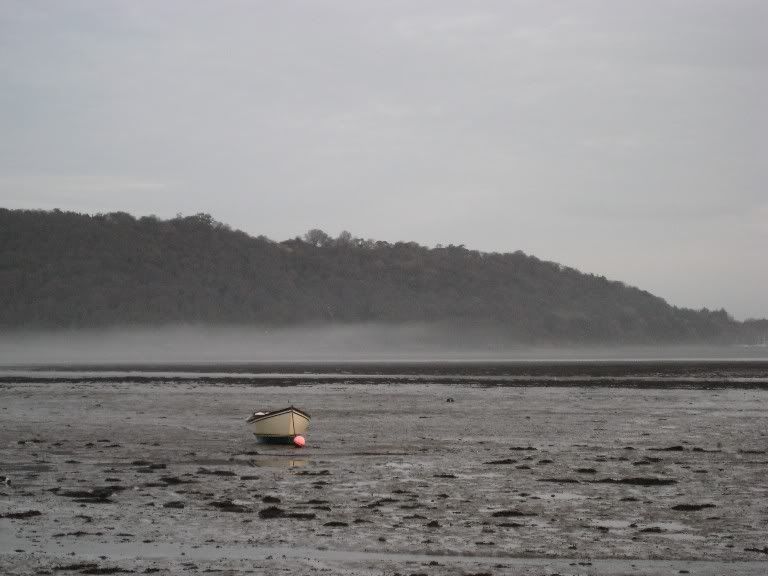
The tidal range was only about 5m, but with the bay being so flat, the tide seemed miles out. Clounds of Oystercatchers screeched, wheeling against the snowy background. We were hoping to leave around 12:00, so killed a few hours with a cooked breakfsat at a local cafe and a trip to the supermarket. Feeling fragile, and expecting rough seas after last night's wind later on, I stuck with black coffee.
The tide crept towards the boat as the morning progressed, and gradually, Camelot began to float.
With inches under the keels, Huw fired up Camelot's inboard diesel and we crept away from the harbour and out into deeper water. It was great to be afloat and a sense of anticipation for the journey ahead filled us all.
The still waters lapped against Camelot's hull as we motored slowly through the Menai Straits. It was the first time I'd been through, and I was surprised how much wildlife there was to be seen, particularly birds:
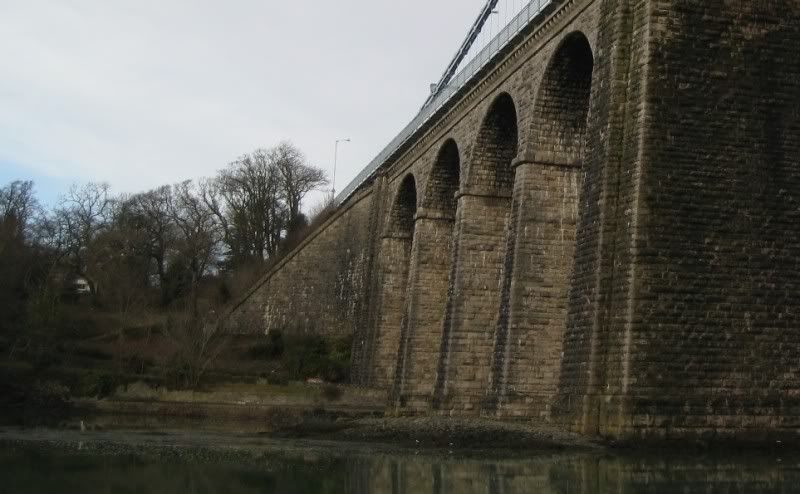
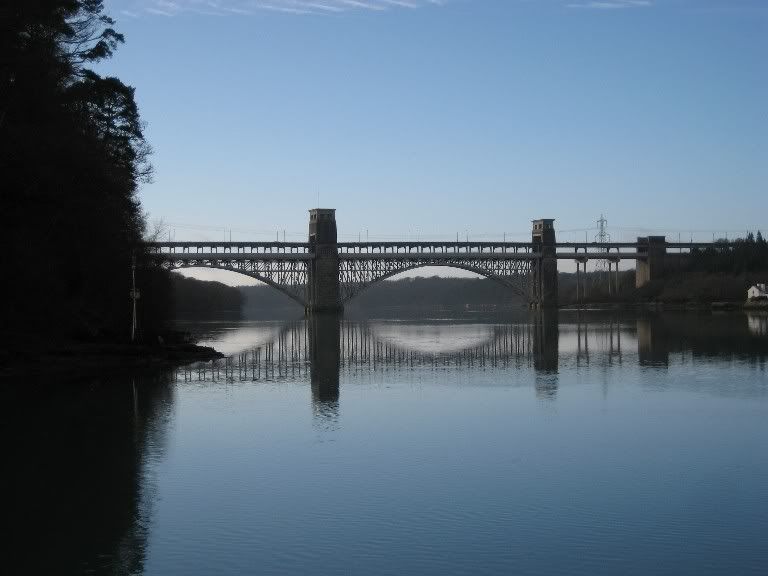
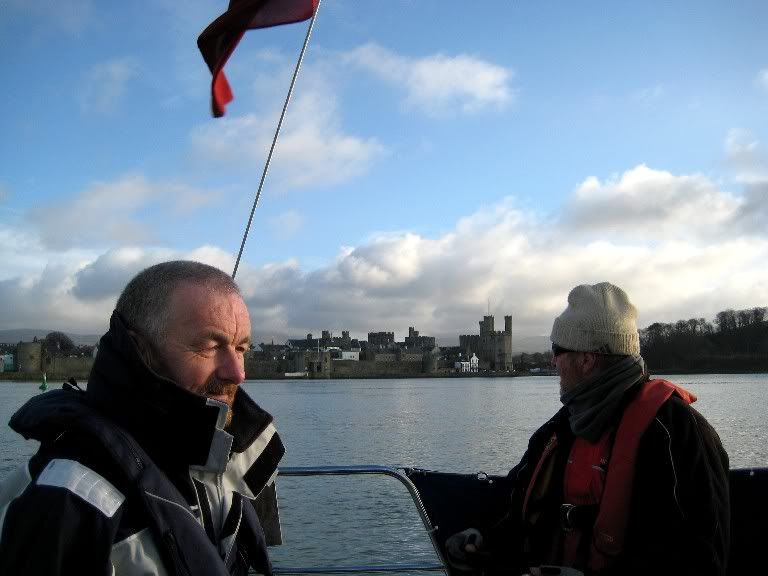
We followed the pilotage instructions and sailed under bridges, past rocky ledges and castles. A beautiful stretch of water, well worth a look.
We sailed on, past Port Dinorwic to Caernarfon - a place I had visited as a child, although I remember little other than the great castle.
As we motored on past Caernarfon the straits opened, sand below and dunes either side, just like an estuary. Huw referred to the pilot instructions. We followed the narrow channel, from buoy to buoy, the remains of last nights swells lifting and breaking on the sandbanks literally inches below the surface in places. With the echo sounder not playing ball, we relied on the channel markers, and they did not lead us astray. Finally, we passed the last of them, and exited the straits, relieved.
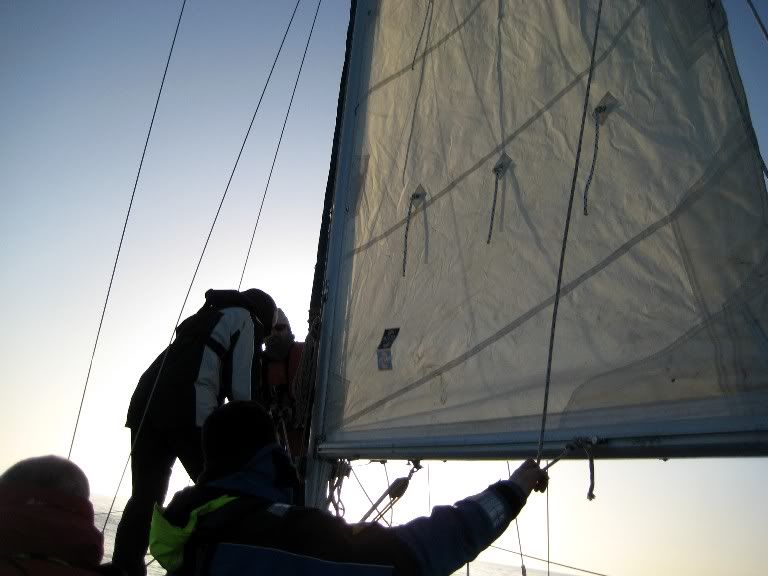
The course to steer was 225T by the GPS. It was late afternoon, the skies cloudless and a pale January sun inched towards the horizon. Huw wanted to ensure the sails were up before dusk, so that nobody would need to be working the deck after dark. We set about our task:
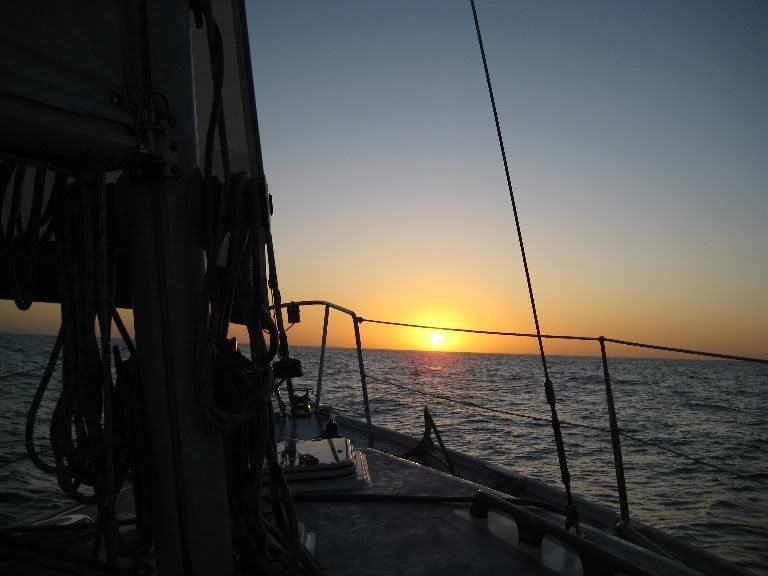
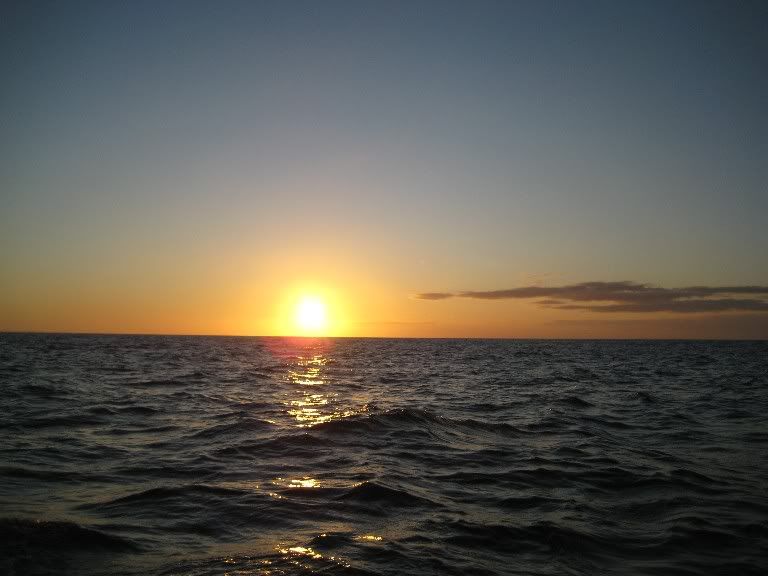
It promised to be a cold frosty night. Wisps of cotton wool cloud wrapped the North Wales mountains, keeping them warm as we steamed Southwestwards towards the setting sun.
We soon picked up the light on Bardsey Island, the end of the Lleyn peninsula, and night fell. The sky was full of stars and a few of us sat on deck discussing how to navigate by them. We quickly realised that. although we could find Polaris with little diffiulty, we had no real idea how to do it, and not enough food on board to try an experiment.
Orion was prominent. I've always loved him. It reminds me of frosty winter nights staring up, usually away from home - there are no stars visible from Bridgend anymore, too much light pollution.
An hour's kip and I awoke to the smell of Friday night curry. Huw had cooked a spicy vegetable curry with mushroom rice. Although delicious, I'd woken with a headache, and didn't finish it. I helped Huw hand it up into the cockpit, hands reaching down from the darkness.
I was helming from 01:00 until 02:00, an exhilarating experience, the boat cutting through the waves in the dark. A light in the South East caught my eye. Flashing 4 times every 15 seconds, the chart said it was Strumble head. That was when we realised how much ground we had covered. A quick chat with Huw and a check on the GPS showed that we would be at the Bishops and Clerks before dawn.
I've dived these islands, their associated stacks and submerged rocks for 20 years. I'd looked forward to sailing through them, but if we did that at night, and I wasn't on watch, it was a much more daunting proposition. We did some further calculations and agreed to run well to the West of the hazards and then cut South just to the West of Skokholm as dawn broke. I finally headed for my bunk at 03:30.
When I woke, 20 minutes late for the start of my next watch, dawn was about to break, and Skokholm was in sight.
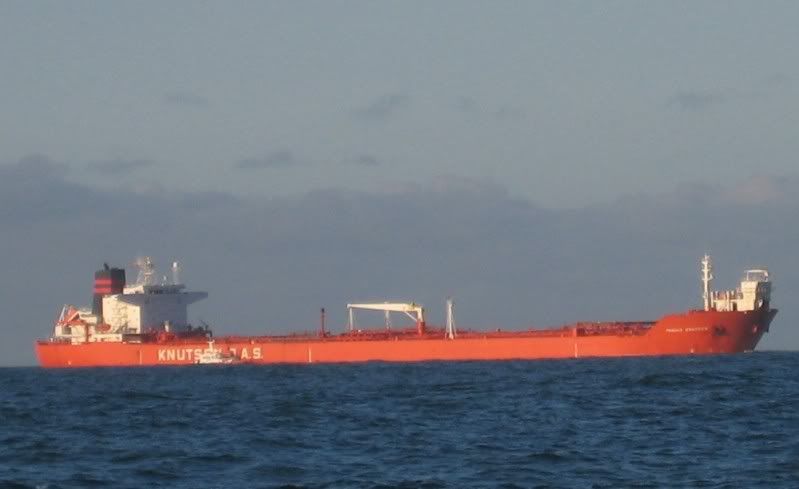
We could see the traffic increase as we neared the busy port of Milford. After leaving the Menai straits, we saw only one or two isolated vessels in the distance all night. Now we could see a number of boats , presumably tankers, toing and froing, smaller boats (pilots) attending them as the new day started.
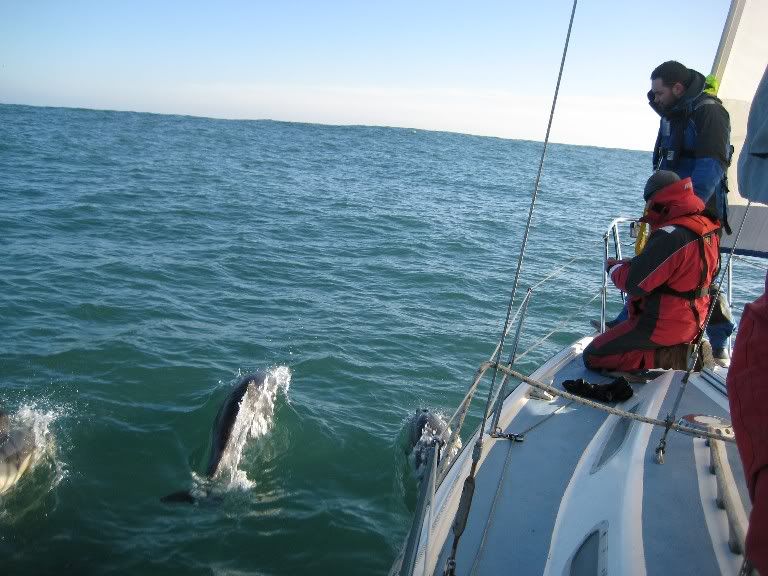
Spirits raised with the new day, and the boat woke up and became busyonce more. Breakfast was served, bacon sarnies all round. Not a big eater in the morning, some toast was the order of the day for me. The sun crept upwards, and it actually felt warm. Spirits were high and again, and again, people said 'I can't believe how lucky we are '.But it got better. I spied a splash of to starboard under the sail. It was quickly followed by another, and I knew dolphins were about to join us. I stayed in the cockpit as the others grabbed cameras and headed for the bows.
In June last year, and again in September, I'd seen a pod of mixed dolphins and porpoise just off the heads at Milford. They were here again, about 20-30 of them. The dolphins, complete with calves, played in the bow wave. The porpoise were more shy, staying slightly further from the boat, but still playing quite clearly, jumping, spinning and generally enjoying themselves.
Things were going so well, one Allan said that it was on;y a matter of time before we spotted a suitcase full of money floating past. Sadly, he was wrong.....
Saturday was a lazy day. The boat was sailing itself, and we clocked up the miles. Fighting the tide off Milford, with the tide past the Gower and up the Glamorgan coast. The scenery became very familiar to all of us, this was our home cruising ground. The day came to a beautiful end as we chugged up the channel:
Darkness fell once more and we could make out the lights at aberthaw and Wenvoe television masts. It seemed milder than last night for the first few hours, but got much colder as we approached Cardiff. A clunk in the darkness sent us rushing for torches and we spent a nervous couple of hours avoiding floating debris, from small twigs to larger logs.
We were soon rounding the Ranie buoy and entered the locks at Cardiff bay at just after 01:00 hrs.
A quick run across the bay and we were berthed on C pontoon shortly afterwards. We did open a beer or two, but I fell asleep drinking my first. Cold, tired, but very happy.
Welcome to the Blog of Ishtar, a Cobra 850 28ft Sailing yacht based in Cardiff Bay
We've just moved Ishtar to a mooring in the river Cleddau, a few miles up river from Miford Haven. Hoping to do some exploration of the Pembrokeshire national park. Sailing wise, that is, we've dived the coast down here for 20 years.
The trip down:
We left Cardiff at the top of a 12.2m tide - Louise went below as she'd been on nights and I motor sailed us, past the outside of the Nash and Scarweather sands, touching 10 knots speed over ground with wind and engine. The day brightened after a wet start.
The remaining wind vanished and we anchored off Oxwich bay, for an evening of curry and fishing. The former was more successful than the latter.
The next day we set off early, punching the last of the flood as we headed West. We were joined by common dolphin, playing in the bow wave and seemingly, teaching their young the rules:
A short video:
Some chop off St Govan's and punching the tide again off Freshwater West, but we finally made Milford around 17:00. Delighted.
Up the river, past Milford, Pembroke and Neyland and under the Cleddau bridge:
Navigating the upper Cleddau was easy, with the help of the invaluable 'Sea guide to Pembrokeshire' by Tom Bennett, published by Imray, ISBN 978 085288 99 0
We arrived at our temporary mooring, Llangwm, and dived to set up our mooring chains:
The upper reaches of the Cleddau are beautiful and unspoilt, and Llangwm is a perfect and peaceful mooring. We are so lucky to be able to 'borrow' a mooring there for the summer.